

How to Practice Beginner English Speaking Fluency for Socializing
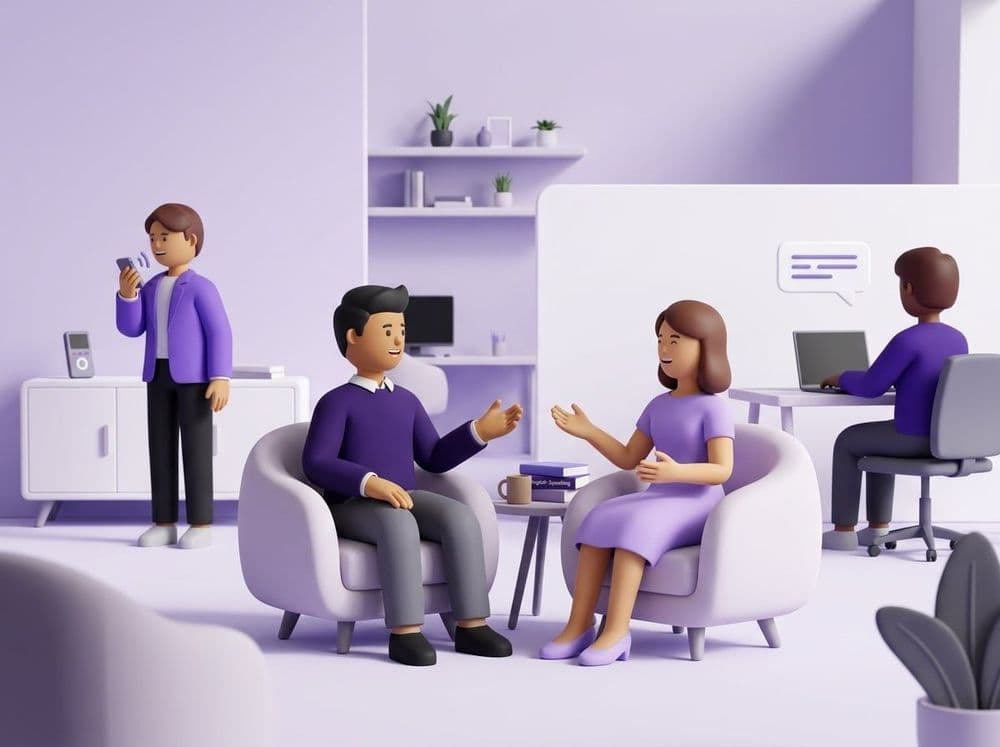
Stop translating in your head. Learn how to practice beginner English speaking fluency to build verbal muscle memory for casual social conversations.

Everyday social interactions like ordering coffee or chatting with neighbors require immediate and spontaneous responses. Relying on mental translation causes awkward pauses that disrupt the natural flow of these conversations. This guide shows you how to practice beginner English speaking. It focuses on building fluency for socializing through verbal muscle memory. You will also find a daily routine to boost your speed.
Key Takeaways
Below are the key takeaways in this guide:
- Verbal muscle memory: Speaking requires physical mouth practice to build the speed needed for real social events.
- The translation freeze: Hesitation happens when you try to translate words from your native language instead of using automatic English phrases.
- Active output vs passive input: Loora turns passive input into active output by acting as a 24/7 speaking partner that reacts, corrects, and pushes you to improve, unlike passive video watching.
The Mechanics of Verbal Muscle Memory
You might freeze during small talk because you experience a mental delay while translating in your head. This "Translation Freeze" is a common physical bottleneck. Your brain already knows the vocabulary, so your mouth just needs physical practice to say the words quickly.
I often observe expats who can read complex emails easily. But when a neighbor asks about their weekend, they suddenly freeze. Reading is a passive skill that allows you time to think. Speaking is an active skill that demands instant speed.
Listening and speaking use completely different physical muscles. When you only listen to English, you build strong passive input skills. To achieve true beginner speaking practice, you must understand the difference between active vs passive learning. You need to speak out loud repeatedly to train your mouth to form sentences without a mental delay.
The Passive Learning Trap: Self Study vs Active Practice
Replacing passive absorption with active speaking (output) is the only way to build conversational speed for social events. When comparing an AI vs self-study approach, a dedicated AI English tutor forces you to talk out loud, so you never get trapped in your own head.
Comparison: Loora vs YouTube vs Movies and Television
| Feature | AI Speaking Coach Loora | Passive Self Study YouTube | Passive Immersion Movies and Television Shows |
|---|---|---|---|
| Speaking focus | Focuses entirely on live speaking fluency. It forces you to speak out loud and respond to questions instantly. | Focuses on passive listening and grammar rules. You watch teachers explain concepts but never actually speak. | Focuses on passive listening for entertainment. You hear natural English but don't practice forming your own words. |
| Scenario realism | Simulates real social situations perfectly. The AI acts like a real person at a coffee shop or a neighborhood party. | Offers fixed video lessons. You watch a scripted situation that doesn't change or react to your specific voice. | Shows highly scripted entertainment scenarios. The situations are dramatic and rarely match normal daily life. |
| Social and Everyday relevance | Adapts directly to your daily life. You practice the exact survival phrases you need for your specific neighborhood interactions. | Provides general phrases for everyone. The examples might not fit your specific social needs or local environment. | Uses fast slang made for native speakers. This vocabulary is often too complex for beginner social events. |
| Role-play flexibility | Allows you to guide the conversation. You can change the topic anytime and the AI follows your lead immediately. | Offers zero flexibility. You must watch the video exactly as the creator recorded it without any input. | Offers zero flexibility. You are just a viewer watching a finished story unfold on the screen. |
| Multi-turn dialogue | Supports endless back-and-forth conversation. The AI asks follow-up questions to keep you talking naturally and quickly. | Provides one-way communication. The teacher speaks to the camera and you just listen in silence. | Provides one-way communication. The actors speak to each other while you sit silently and read subtitles. |
| Feedback depth | Gives instant corrections on your grammar and pronunciation. It highlights your mistakes and shows you how to sound more natural. | Gives zero personal feedback. You never know if you are saying the words correctly or at the right speed. | Gives zero personal feedback. You can't ask the characters to explain a difficult word or correct your accent. |
| Conversation pressure simulation | Recreates the feeling of a live chat. It helps you get used to answering quickly in a safe space. | Has no pressure at all. You can pause the video whenever you feel confused or need a break. | Has no pressure to respond. You only feel pressure to read the subtitles fast enough to follow along. |
| Context awareness | Remembers what you said earlier in the chat. It keeps the conversation relevant to your specific skill level. | Doesn't know who you are. The video plays the exact same way for every single viewer. | Doesn't know who you are. The story continues whether you understand the spoken words or not. |
| Preparation for real-world interactions | Builds fast verbal muscle memory. You feel ready to talk to real people because you already practiced the exact conversation. | Builds mental knowledge of grammar. You know the rules but might still freeze when someone says hello. | Builds listening skills. You might understand a native speaker but still struggle to reply at a normal speed. |
| Custom scenario creation | Lets you invent any situation. You can tell the AI to act like a barista or a new friend at a party. | Limits you to the video title. You can't change the lesson to fit your exact day or schedule. | Limits you to the director's vision. You can't change the plot to practice your own life events. |
| Best real-world outcome | You talk to neighbors and shop workers without freezing. You feel confident because you already practiced out loud. | You understand basic grammar rules. You might pass a written test but still struggle to speak during small talk. | You recognize common English sounds. You might enjoy English media but still rely on subtitles to understand everything. |
A Daily Routine to Practice Basic English Conversation
A structured daily practice routine is the fastest way to build conversational speed in a private setting. To practice basic English conversation without pressure, start with a five-minute warm-up of saying common greetings out loud. Next, spend ten minutes on focused active speaking using an AI partner to force immediate replies. Finally, spend five minutes reviewing your mistakes to lock in that new muscle memory.
Active Speaking Habits vs Passive Habits
| Do This (Active Speaking Habits) | Instead of This (Passive Habits) |
|---|---|
| Speak your answers out loud immediately to build mouth speed. | Read dialogue silently in your head without moving your lips. |
| Practice with an AI tutor that forces a fast, unscripted reply. | Watch a YouTube video and pause it every time you feel confused. |
| Repeat the same social conversation until you answer without hesitating. | Move to a new lesson before mastering the speed of the current one. |
| Focus on the rhythm and speed of the full sentence. | Stop mid-sentence to search for one perfect vocabulary word. |
Step 1 Automating Survival Phrases
Beginner English for social events relies entirely on automated chunks of speech. You don't need to invent a brand new sentence every time you order a coffee or buy groceries. You just need to master a few short survival phrases so completely that they require zero mental translation.
Start by practicing greeting people and introductions out loud in your living room. Say "Hi, how are you doing today?" ten times fast. You want to train your mouth to produce the entire phrase as one single sound. This physical repetition removes the mental delay, so you never freeze when a cashier says hello.
Step 2 Practicing Multi Turn Small Talk
Once you automate your basic greetings, you must practice the back-and-forth rhythm of a real chat. True social English fluency requires you to listen to a question and reply immediately. You can't build this specific speed by reading a textbook or watching a movie.
Speaking for socializing means answering open-ended questions out loud. Use an interactive tool like Loora to simulate real-life scenarios, like a neighbor asking about your weekend plans. The AI will respond dynamically to whatever you say. This unscripted practice helps you overcome fear. You learn to keep the conversation moving, even with small mistakes.
Conclusion
Freezing during casual small talk is a simple mechanical issue, not a permanent failure. Your brain just needs the physical mouth practice to retrieve words at a normal conversational speed. When you evaluate an Ai English Tutor (Loora) vs YouTube vs passive listening, the difference in active output becomes very clear. Knowing vocabulary is helpful, but physically producing it under social pressure is what actually builds speed.
Start your daily routine by automating your basic survival phrases out loud. Then use scenario-based practice tools to rehearse the back-and-forth rhythm of multi-turn conversations. This structured speaking practice accelerates your transition from passive reading to speaking naturally. It turns isolated vocabulary into the fast, automated responses required for making friends in English and handling real neighborhood interactions without hesitation.