

Daily Checklist to Improve Beginner English Speaking for Kids
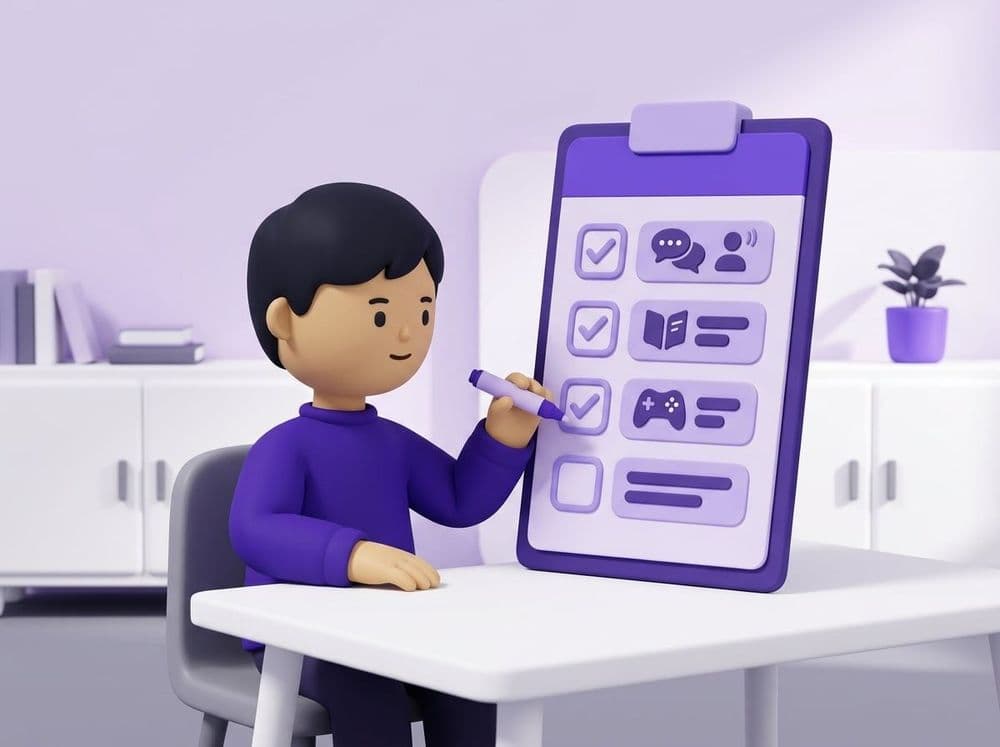
Transform your child's passive screen time into active conversation. Use this daily checklist to improve beginner English speaking for kids without pressure.

Early childhood language learning often involves a phase where a child consumes hours of English media without ever producing a single spoken sentence. Relying solely on this passive screen time stalls language development in the silent phase and fails to build actual conversational muscle. Using a daily checklist is the best way to improve beginner English speaking skills for kids, providing an actionable routine to prompt active speech alongside a clear comparison of digital practice tools.
Key Takeaways
Below are the key takeaways in this guide:
- Passive to active transition: A child must move from simply hearing English to actively producing spoken words to build true confidence.
- Daily language micro-habits: Short, 5-minute daily routines prompt natural speech without causing pressure or anxiety.
- Contextual learning: Grouping words by real-world situations helps beginners use vocabulary naturally rather than just memorizing isolated lists.
- AI speaking coach: Loora turns passive input into active output by acting as an Artificial Intelligence speaking partner that provides a safe, judgment-free practice zone with real-time feedback, unlike passive videos or simple gamified apps.
The Difference Between Passive Listening and Active Speaking
Early childhood language learning always starts with a silent period. A child listens to English cartoons or songs and absorbs the sounds. This builds a foundation of passive listening. But hearing a language doesn't automatically create spoken confidence.
To speak, a child must practice the physical habit of forming words. This requires active speaking. Without gentle prompting, a beginner can stay stuck in the silent phase for months. They understand what you say but refuse to reply.
You have to bridge this gap. You must invite them to use the words they already know in safe, low-pressure moments.
The Daily Action Checklist for Eliciting Spoken English
I helped a parent guide a completely silent beginner into talking using just a five-minute car ride routine. Instead of testing the child with flashcards, the parent turned the morning drive into a simple naming game.
Over time, that child transitioned from passive nodding to active vocabulary use. The secret is building a daily English checklist for children based on micro-habits. You want to weave active output into moments that already exist in your day.
Morning and Routine Integrations
Teaching words in isolated lists rarely works. You need context-first learning. This means using thematic vocabulary, which is simply grouping words by the situation where you actually use them. Morning routines are perfect for these daily language routines.
- Offer breakfast choices by holding up two items and asking the child to name the one they want. Say "Apple or banana?" to prompt a spoken answer.
- Name clothing items as the child puts them on while getting dressed. Ask "Where are your shoes?" to encourage them to find and name the object.
- Play a car ride game by picking a color and asking the child to point out objects of that color outside the window. This connects the English word directly to their physical world.
Playtime and Contextual Elicitation
A beginner needs to hear and use a word multiple times in different ways before it sticks. Playtime offers the best comprehensible input because the child is relaxed. Use these English conversation starters to build beginner speaking practice.
- Avoid asking questions that end in a simple yes or no because it stops the conversation. Ask "What is the bear doing?" instead of "Is the bear sleeping?" to force word retrieval.
- Ask a gentle follow-up question when the child gives a one-word answer. If they say "Car," reply with "Is the car fast or slow?" to expand the dialogue.
- Describe what the child is doing while they play so they hear the context. Say "You are building a tall tower" to connect the physical action to the spoken vocabulary.
Essential Dos and Donts for Correcting Mistakes
Constant grammatical interruption causes language anxiety and suppresses a beginner's willingness to speak. When an adult jumps in to fix every small error, the child learns that speaking is a stressful test. You must focus on correcting mistakes naturally to keep the conversation flowing.
- Do wait 5 seconds for a response: Give the child time to physically form the words instead of answering for them.
- Do use positive reinforcement: Always praise the physical effort of speaking out loud before addressing any vocabulary errors.
- Do model the right word naturally: If they say "I runned," simply smile and reply "Yes, you ran very fast" to provide the correct sound without stopping their momentum.
- Don't interrupt their sentence: Let them finish their thought completely so they don't lose their conversational flow.
- Don't force textbook accuracy: Prioritize being understood and active output over perfect grammar during these early stages.
You must adapt your parent facilitator role to encourage active output. This means shifting your daily habits to prioritize building spoken confidence over passive repetition.
Parent and Educator Best Practices Table
| Do This (Active Support) | Instead of This (Anxiety Inducing) |
|---|---|
| Wait 5 full seconds for a response to allow word retrieval. | Answering for them the moment they hesitate or look confused. |
| Model the correct word naturally in your own reply. | Stopping their sentence to explain rigid grammar rules. |
| Praise the physical effort of producing spoken English. | Only praising perfect pronunciation or complete accuracy. |
| Ask open-ended questions to force active vocabulary use. | Asking yes or no questions that kill the conversational flow. |
Executing Your Checklist Free Tools Versus Artificial Intelligence English Tutors
To execute this daily checklist when you are busy, you need supplementary tools. Most parents reach for free apps or videos, but these often fail to cross the bridge into actual speaking.
You must understand how Free tools vs Ai English Tutor (Loora) options impact your child's active output. This comparison shows how an Ai English Tutor (Loora) vs Duolingo vs YouTube stack up for eliciting real speech.
Feature Comparison Loora Versus Duolingo Versus YouTube
| Feature | General Media (YouTube) | Gamified Apps (Duolingo) | AI Speaking Coach (Loora) |
|---|---|---|---|
| Speaking focus | The platform focuses entirely on passive listening. Children hear native speakers but are never required to produce a single word themselves. | The app focuses on text translation and basic vocabulary retention. It relies on pattern matching rather than prompting genuine communicative use of the language. | The platform focuses exclusively on live speaking fluency. It requires the learner to actively generate unique speech and engage in real conversations. |
| Scenario realism | Realism is completely absent since the child is only watching a recorded video. There is no interaction or adaptation to the learner's responses. | Scenarios are fixed and pattern-based. The learner follows rigid conversational trees that do not simulate natural human interaction. | Scenarios are dynamically interactive and adapt to the user. The AI responds naturally to whatever the learner says to create a realistic conversational flow. |
| Age/Level Relevance | Content is general-purpose and often highly scripted. It rarely matches the specific, immediate needs of the child's daily routine. | Lessons are built on a rigid, one-size-fits-all progression path. They are not contextualized to real-world age or level situations. | Practice is contextualized to the learner's specific level and needs. The AI acts as a flexible partner that adjusts its vocabulary to match the speaker. |
| Role-play flexibility | The user has zero flexibility to influence the content. They can only pause or rewind the pre-recorded video. | The user is restricted to pre-built, rigid lessons. There is no open-ended interaction or room to explore off-script topics. | The user can engage in open-ended custom interaction. They can discuss any topic imaginable without following a rigid conversational tree. |
| Multi-turn dialogue | Communication is strictly one-directional. The screen talks to the child, and the child simply listens. | Interaction is mostly one-directional with simple prompts. There is no true back-and-forth conversational flow. | The AI engages in a true back-and-forth conversational flow. It asks follow-up questions and applies realistic pushback to build real-time thinking. |
| Feedback depth | The platform provides zero feedback. The child has no way of knowing if they are pronouncing words correctly. | The app offers basic right or wrong text feedback. It lacks intense, phoneme-level pronunciation scoring and accent correction. | The platform provides real-time feedback on grammar and pronunciation. It highlights mistakes as they happen so the learner can make immediate corrections. |
| Conversation pressure simulation | The experience is entirely passive watching. There is no pressure to respond or think quickly in English. | The app relies on isolated drills and translation games. It does not simulate real dialogue flow or the pressure of a live conversation. | The tool simulates the natural pressure of a live conversation. The user must think on their feet and respond to unpredictable questions. |
| Context awareness | The video cannot understand the conversational context of the room. It just plays the recorded script. | The app does not understand conversational context. It simply checks if the inputted text matches the pre-programmed answer key. | The AI understands the conversational context perfectly. It provides suggestions for more natural, native-sounding expressions based on the specific topic. |
| Preparation for real interactions | Passive listening rarely transfers to actual speaking. The child learns to understand English but not how to use it. | Memorizing vocabulary in isolation does not transfer well to actual speaking. Knowing a word and using it fluently are two different skills. | Practice transfers directly to actual speaking. The continuous interactive dialogue builds the automatic recall needed for real-world conversations. |
| Custom scenario creation | The user cannot set specific practice situations. They must search for a video that closely matches their topic. | The user cannot create custom scenarios. They must complete the pre-set curriculum in the exact order provided by the app. | The user can set specific practice situations effortlessly. They can rehearse a real upcoming conversation by creating a custom scenario. |
| Best real-world outcome | The learner achieves passive vocabulary recognition. They might understand a cartoon but will struggle to speak to a friend. | The learner develops basic sentence structure recognition. They can pass a digital quiz but will freeze during a live chat. | The learner achieves confident active speaking. They learn to handle real, unpredictable conversations without hesitation. |
A quick look at Loora vs Duolingo reveals a stark difference in their approach. Duolingo gamifies the learning process with points, but it can't replicate the flow of a live conversation. Similarly, an AI English tutor vs YouTube comparison shows that while videos are great for entertainment, they lack the real-time feedback required to fix pronunciation habits. Loora's 24/7 availability and speed-control snail button make it the ideal environment to practice actual speaking.
Conclusion
Speaking confidence is a mechanical skill built through consistent, low-pressure daily habits rather than passive screen time. To improve kids English skills, you must actively prompt them to use their vocabulary in real-world contexts. Understanding what to say is different from being able to say it out loud. You have to bridge that gap with intentional practice to overcome the language barrier. Start by integrating just one item from this checklist into your morning routine tomorrow, and use scenario-based practice tools to rehearse those conversations actively.