

Exercises to Learn Intermediate English Speaking Skills for Restaurants
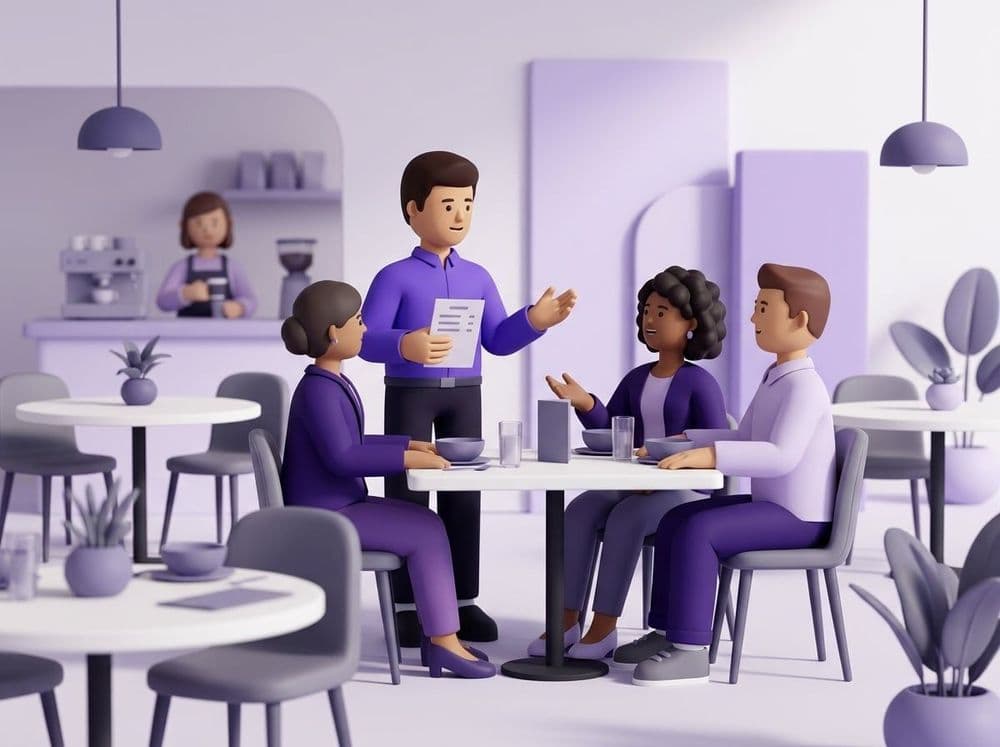
Looking for exercises to learn intermediate English speaking skills for restaurants? Build confidence with practical role-plays and sentence transformations.

Fast-paced hospitality environments demand rapid responses to unexpected questions from waitstaff during business lunches or social dinners. Using the correct polite register in these moments prevents social friction and projects competence to your colleagues and clients. To help you build conversational muscle memory, this guide provides targeted exercises to learn intermediate English speaking skills designed specifically for restaurants.
Key Takeaways
Below are the key takeaways in this guide:
- Conversational Muscle Memory: Repeatedly practicing out loud trains your brain to handle fast-paced interactions without freezing.
- Polite Register Importance: Mastering modal verbs prevents blunt demands and ensures smooth communication with waitstaff.
- Transformation Tactics: Converting simple statements into polite requests builds the exact conversational mechanics needed for dining situations.
- Judgment-Free Practice with Loora: Loora provides a safe practice environment available 24/7 with custom role-play scenarios so you can rehearse high-pressure interactions without the cost or anxiety of a human tutor.
Restaurant Speaking Exercises for Intermediate Learners
I recently attended a high-stakes business lunch where the waiter rattled off the daily specials at lightning speed. My brain locked up trying to process the information, so I defaulted to pointing at the menu and giving a blunt command. That moment perfectly illustrates the gap between knowing vocabulary and actually deploying intermediate English skills under pressure.
To close that gap, you need targeted restaurant speaking exercises that train your response speed.
Mechanical Differences in Register
- Survival English: Focuses purely on the transaction. Example: "I want the chicken."
- Polite Register: Uses modal verbs and hedging to soften the request. Example: "Could I please have the chicken?"
- The Goal: Moving from survival English to the polite register requires structural shifts rather than just adding the word "please."
Arriving and Ordering: Mastering Polite Requests
Transforming a direct demand into polite phrasing is a core mechanical skill for any dining scenario. Read the blunt statements below and transform them into polite requests out loud, which builds the muscle memory needed to soften your tone naturally.
Exercise 1: Asking for guidance
- Blunt: "Tell me what is good."
- Task: Transform this into a polite request for a recommendation.
- Waitstaff Follow-Up: "Are you in the mood for seafood or perhaps a steak?"
Exercise 2: Selecting a meal
- Blunt: "I will take the salmon."
- Task: Transform this into a softer, modal-driven choice to order the salmon.
- Waitstaff Follow-Up: "Excellent choice. How would you like that prepared?"
Exercise 3: Requesting table items
- Blunt: "Give us more bread."
- Task: Transform this into a polite inquiry asking for another bread basket.
- Waitstaff Follow-Up: "Right away. Can I get you any more olive oil to go with that?"
Practicing these transformations out loud prepares your brain for unexpected waitstaff questions. That means you won't freeze when the conversation shifts away from your planned script.
Managing Menu Modifications and Dietary Needs
Handling food allergies or adjusting a dish requires precise communication. A misstep here causes confusion in the kitchen. Your restaurant English practice must include the mechanics of modifying an order smoothly.
Exercise 4: Substituting ingredients
- Blunt: "No fries. I want a salad."
- Task: Transform this into a polite request to swap the side dish.
- Waitstaff Follow-Up: "We can certainly do that. Would you prefer a vinaigrette or a creamy dressing?"
Exercise 5: Stating a restriction
- Blunt: "I am allergic to nuts."
- Task: State the allergy and ask a clarifying question to confirm the dish is nut-free.
- Waitstaff Follow-Up: "I will double-check with the chef right now to ensure there is no cross-contamination."
Exercise 6: Requesting items on the side
- Blunt: "Put the sauce separate."
- Task: Request the sauce on the side using a polite modal verb.
- Waitstaff Follow-Up: "Absolutely. Do you need any extra sauce just in case?"
These exercises focus entirely on the mechanics of the transaction. True vocabulary building for menu navigation happens when you learn how to structurally frame your requests rather than just memorizing a list of ingredients.
Resolving Issues Diplomatically: Sending Food Back
Errors happen, but addressing them requires strong dining conversation skills. Sending food back is the ultimate test of intercultural diplomacy and reading the room. You must remain firm but polite.
Exercise 7: Addressing an undercooked dish
- Scenario: Your steak is rare, but you ordered it medium-well.
- Task: Formulate a polite opening statement to report the undercooked food without sounding accusatory.
- Unexpected Waitstaff Response: "I apologize, but the chef usually prepares this cut a bit pink. Would you still like me to take it back?"
- Your Reply Task: Use on-the-spot communication to insist politely that it needs further cooking.
Exercise 8: Handling a completely wrong order
- Scenario: You are served chicken, but you ordered pasta.
- Task: Catch the waiter's attention and point out the wrong dish gently.
- Unexpected Waitstaff Response: "Oh, I thought your colleague ordered the pasta. Let me check the ticket. Are you in a rush?"
- Your Reply Task: Apply solid conversational mechanics to confirm your timeline while requesting the correct meal.
These scenarios force you to think on your feet. But written practice only goes so far. Understanding what to say is different from being able to say it under pressure, which means transitioning to verbal rehearsal is the next logical step.
Taking Your Exercises to the Real World: AI Tutors vs Private Teachers
Written exercises must be spoken out loud to build spoken fluency, forcing a choice between an AI vs human English teacher to develop that muscle memory. When evaluating practice tools, you might search for a Loora vs Lingoda comparison. But analyzing the core models of an Ai English Tutor (Loora) vs private teacher vs Lingoda alternatives like Preply reveals the most effective way to practice restaurant English.
Comparison Table: AI Speaking Coaches vs Human Tutoring Platforms
| Dimension | Loora | Private Teachers | Preply |
|---|---|---|---|
| Speaking focus | Focuses on live professional speaking and real-time conversations. The user must actively generate unique speech rather than relying on translations. | Focuses on unstructured or textbook-guided human conversation. The interaction relies heavily on the individual teacher's methodology. | Matches students with a massive marketplace of 32,000 tutors for personalized human instruction. The speaking focus varies based on the tutor selected. |
| Scenario realism | Simulates real professional situations like a high-stakes business dinner. The AI responds dynamically and applies pushback like a real stakeholder. | Role-play realism depends entirely on the teacher's acting ability. Many teachers default to predictable dialogues from standard textbooks. | Tutors can simulate real-world scenarios if instructed. The realism is limited by the tutor's specific industry knowledge and improvisational skills. |
| Professional relevance | Built specifically for career and business professionals. It offers specific modules designed for job interviews, business meetings, and professional presentations. | Highly variable based on the teacher's background. Finding a teacher with actual corporate dining or business experience is difficult and expensive. | Offers a specific B2B arm called Preply Business for corporate training. Users must actively filter the marketplace to find tutors with relevant business expertise. |
| Role-play flexibility | Users can create highly specific custom scenarios at any time. You can instantly set up a role-play for a specific restaurant or a difficult client lunch. | Requires advance notice to prepare specific role-play materials. Flexibility is strictly limited to the scheduled lesson time. | Tutors can adapt to requests if given enough warning before the lesson. The platform provides AI tools to help tutors plan these custom lessons. |
| Multi-turn dialogue | Supports deep conversations without set time limits. The AI asks follow-up questions and forces the user to think on their feet. | Excellent at natural multi-turn dialogue and cultural exchange. The teacher can guide the conversation organically based on the student's responses. | Delivers genuine human connection and back-and-forth conversation. The quality of the dialogue depends entirely on the tutor's conversational skills. |
| Feedback depth | Provides instant feedback on pronunciation and grammar mistakes as they happen. It also offers a comprehensive post-conversation review with native-speaker examples. | Feedback is often delayed to avoid interrupting the flow of conversation. Granular pronunciation correction depends on the teacher's specific phonetic training. | Tutors provide personalized feedback based on their own teaching style. Consistent feedback tracking across multiple lessons is not guaranteed. |
| Conversation pressure simulation | Simulates the exact cognitive load of a fast-paced environment without the social anxiety of a human judge. It trains response speed in a completely judgment-free zone. | Naturally triggers performance anxiety, which mimics real-world pressure. This can sometimes cause intermediate learners to freeze up during practice. | The live video call format creates immediate social pressure. This is excellent for testing skills but can be intimidating for learners struggling with confidence. |
| Context awareness | Maintains strict context throughout the entire custom scenario. It understands the nuances of a business lunch and evaluates your use of the polite register accordingly. | Human teachers possess perfect context awareness and can read visual cues. They understand the cultural subtleties of dining etiquette instinctively. | Tutors bring their own cultural context to the lesson. Users can select tutors from specific regions to learn localized dining customs. |
| Preparation for real meetings | Allows users to rehearse a specific upcoming conversation the day before it happens. This builds the exact conversational mechanics needed for the actual event. | Can help prep for specific meetings if the schedule aligns. This requires booking a slot well in advance of the actual event. | Users can filter for tutors specializing in meeting preparation. Finding an available tutor right before a crucial event can be challenging. |
| Custom scenario creation | The user sets the exact parameters of the situation instantly. You can dictate the setting, the hostility of the waitstaff, and the dietary restrictions involved. | The teacher usually dictates the scenario based on a curriculum. Customizing the scenario requires negotiation and prep time. | Customization is possible but depends on the tutor's willingness to deviate from their standard lesson plans. |
| Best real-world outcome | Best for building automatic muscle memory and overcoming the freezing barrier. The user learns to deploy intermediate English skills under pressure without hesitation. | Best for nuanced cultural exchange and overcoming the fear of speaking to a real person. | Best for finding affordable human interaction and practicing with a wide variety of regional accents. |
Answer Key and Conclusion
Practicing intermediate English dining exercises requires understanding why a phrase works. Review these grammar highlights to solidify your conversational mechanics.
Exercise 1: "Could you recommend a dish?" Using "could" softens the request, shifting it from a demand to an inquiry about their expertise.
Exercise 2: "I would like the salmon, please." The phrase "would like" is the standard polite register for stating a preference in hospitality settings.
Exercise 3: "Could we possibly get some more bread?" Adding the adverb "possibly" introduces a layer of deference that is highly effective in formal dining.
Exercise 4: "Could I substitute a salad for the fries?" The verb "substitute" clarifies the exact mechanical swap for the kitchen staff.
Exercise 5: "I have a nut allergy. Could you confirm this dish is nut-free?" State the restriction directly, then use a polite modal verb to ask for confirmation.
Exercise 6: "Could I have the sauce on the side, please?" This frames the modification as a polite request rather than a blunt imperative command.
Exercise 7: "Excuse me, but I ordered this medium-well, and it looks a bit undercooked." Saying "excuse me" grabs attention politely, and "a bit" hedges the complaint to avoid sounding aggressive.
Exercise 8: "I believe there has been a mix-up. I ordered the pasta, not the chicken." Starting with "I believe" softens the assertion of the error and gives the waitstaff space to correct it gracefully.
Restaurant English is a professional tool. The conversational mechanics covered here form the foundation of every dining interaction that matters. Knowing the polite register is necessary, but being able to use it under pressure is what separates passive knowledge from spoken fluency.
Start by integrating these sentence transformations into your daily routine when you practice restaurant English, since repetition builds true automaticity. Then use interactive role-plays to rehearse the fast-paced conversations where precision carries the most weight. Tools providing native-speaker examples help cement this knowledge, ensuring you can speak clearly and confidently at your next business lunch.