

Checklist learn intermediate english speaking for call center agents
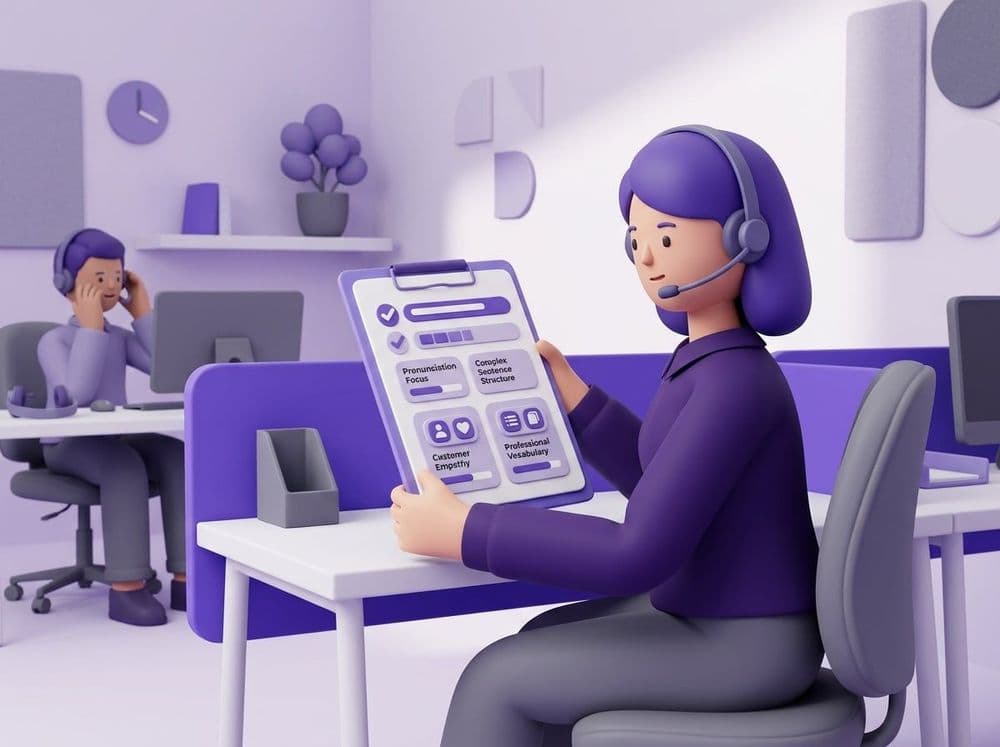
Stop relying on scripts. Use this checklist to learn intermediate English speaking for call center agents, handle angry callers, and improve your QA scores.

BPO environments demand fast and accurate communication, especially when customers go off-script with unpredictable problems. Relying only on a written script causes dead air and damages CSAT scores, so finding a practical checklist for intermediate speaking is essential for protecting your QA metrics. This guide maps out the specific speaking skills needed to manage active call flows, handle angry callers naturally, and practice unscripted conversations before you put your headset on.
Key Takeaways
Below are the key takeaways in this guide:
- Transition phrases: Use natural bridging words to prevent dead air while your system loads account details.
- Active listening: Mirror the customer's problem out loud to confirm understanding and lower their frustration.
- Polite interruptions: Guide angry callers back to the troubleshooting steps without sounding aggressive or rude.
- Structured practice: Free tools like ChatGPT make you write your own practice prompts, but an AI tutor like Loora provides built-in professional role-plays so you can immediately practice handling difficult calls.
Essential Speaking Skills for Call Center Agents
A beginner agent reads a script line by line and freezes when a customer asks an unexpected question. An intermediate agent uses active listening and natural transition phrases to control the conversation. Building your intermediate English skills means you stop relying on the script and start responding to the actual person on the line.
This shift helps you maintain a professional tone and keeps your AHT low. You can solve problems faster when you know exactly how to guide the conversation.
The Call Flow Checklist
This call center English speaking guide breaks down the exact phrases you need for each phase of a live call. Use these checklists to build an active vocabulary that keeps the conversation moving.
Greeting and Verification
- Acknowledge the specific issue: "I understand you are calling about your recent bill."
- Set expectations: "I need to ask two quick security questions, and then we will check your account."
Troubleshooting and Hold Procedures
- Prevent dead air: "My system is loading slowly right now, so please give me just a moment."
- Explain hold procedures clearly: "I need to check this with my support team. May I place you on a brief hold for two minutes?"
- Return from hold professionally: "Thank you for waiting. I have the information we need to fix this."
Closing the Call
- Summarize the resolution: "Today we updated your password and confirmed your new billing address."
- Offer final assistance: "Do you need help with any other part of your account today?"
These standard phrases work perfectly for normal interactions. But when a caller is already upset, standard checklists aren't enough.
Navigating Angry Callers Without a Script
Handling irate customers is the hardest part of any BPO shift. I once listened to an agent try to read a standard apology script to a customer who was locked out of their banking app. The customer only grew angrier because the robotic response felt dismissive.
The agent then switched tactics and used a simple empathy statement to validate the frustration. The caller immediately calmed down and allowed the agent to fix the app issue. Successful de-escalation requires natural mirroring and careful timing. You must show the caller you hear them, even if you have to use polite interruptions to get the call back on track. Use these natural de-escalation phrases to replace robotic apologies.
De-escalation Phrases: Scripted vs Natural
| Instead of this (Scripted) | Say this (Natural) |
|---|---|
| "I apologize for the inconvenience." | "I completely understand why this billing error is frustrating." |
| "Please calm down so I can help." | "I want to fix this for you right now. Can I ask one quick question to find the error?" |
| "Let me repeat what you said." | "Just to make sure I have the details right, you are seeing a double charge on your statement?" |
How to Practice Your Unscripted Call Center Skills
Reading a checklist helps you learn the vocabulary, but it won't stop you from freezing on a live call. Spontaneous speaking requires muscle memory. The cognitive load of trying to translate your thoughts while navigating your computer system is too high for a live shift.
You need active, intermediate speaking practice before you connect to a customer. Practicing by yourself in front of a mirror builds basic recall, but choosing the right interactive tool determines how quickly you build confidence.
Free Tools vs AI English Tutors
Free tools can help you learn new vocabulary, but they rarely prepare you for the pressure of an angry caller. Comparing a general chatbot, a video platform, and a specialized AI English tutor reveals which method actually builds real speaking skills.
Free Tools vs AI English Tutors: Feature Comparison
| Feature | General LLMs (ChatGPT) | Video Platforms (YouTube) | AI English Tutor (Loora) |
|---|---|---|---|
| Speaking focus | Made mostly for typing text. You have to write out your practice scenarios. | Made for passive listening. You watch videos but never actually speak. | Made for live speaking. You talk out loud and get instant feedback on your voice. |
| Scenario realism | Uses text-based chats. You have to tell the AI how to act like an angry customer. | Uses recorded videos. You can watch an agent handle a call, but you cannot join the conversation. | Practices real work situations with you. The AI acts like a difficult caller and pushes back naturally. |
| Professional relevance | Gives general advice. You must build your own BPO vocabulary lists. | Depends on the video. Finding exact call center training takes a lot of searching. | Uses built-in starter scripts made for your exact industry and English level. |
| Role-play flexibility | You can type out different situations, but it doesn't feel like a real phone call. | None. You can't practice or role-play with a recorded video. | You can set up custom situations, like troubleshooting a specific software error. |
| Real back-and-forth talk | You send a message and wait to read the answer. It is very slow. | None. Communication only goes one way. | The AI answers naturally and asks follow-up questions, just like a real person. |
| Feedback depth | Corrects your spelling and text grammar, but can't hear your voice. | None. A video can't tell you if you made a mistake. | Corrects your grammar and pronunciation in real time, plus gives you vocabulary tips after the call. |
| Conversation pressure simulation | Low pressure. You can take five minutes to type an answer. | No pressure. You just sit and watch the screen. | High pressure. You have to think fast and answer follow-up questions immediately. |
| Context awareness | You have to explain your job every time you start a new chat. | Videos give general tips that might not match your specific company rules. | You define the exact call center situation, and the AI adapts to your specific role. |
| Preparation for live calls | Good for drafting emails, but doesn't help you speak faster on the phone. | Good for learning new words, but doesn't build speaking muscle memory. | Prepares you for real calls by practicing the exact situations that lower your QA scores. |
| Custom scenario creation | You have to write long prompts to create a specific customer problem. | You can't create scenarios. You can only search for videos other people made. | You can easily set up a practice call for explaining a late fee to a frustrated client. |
| Best real-world outcome | You learn how to write better support tickets and chat messages. | You learn to understand different accents and hear how native speakers talk. | You are ready to handle unpredictable customer calls with confidence and clear articulation. |
Repeated practice in realistic scenarios builds the automatic recall that professionals need in live situations. A continuous feedback loop ensures you stop making the same mistakes and start speaking naturally.
Conclusion
Call center English is a professional tool that directly impacts your QA metrics and job security. The vocabulary covered here, from managing dead air to using natural empathy statements, is the foundation of every successful customer interaction. Knowing the right phrases is necessary, but being able to use them under pressure separates a beginner reading a script from an intermediate agent managing a call. Start by integrating these transition phrases into your daily workflow, and use structured scenario practice to lower your language anxiety before your next shift begins.