

Exercises to Practice Advanced English Pronunciation for Office Workers
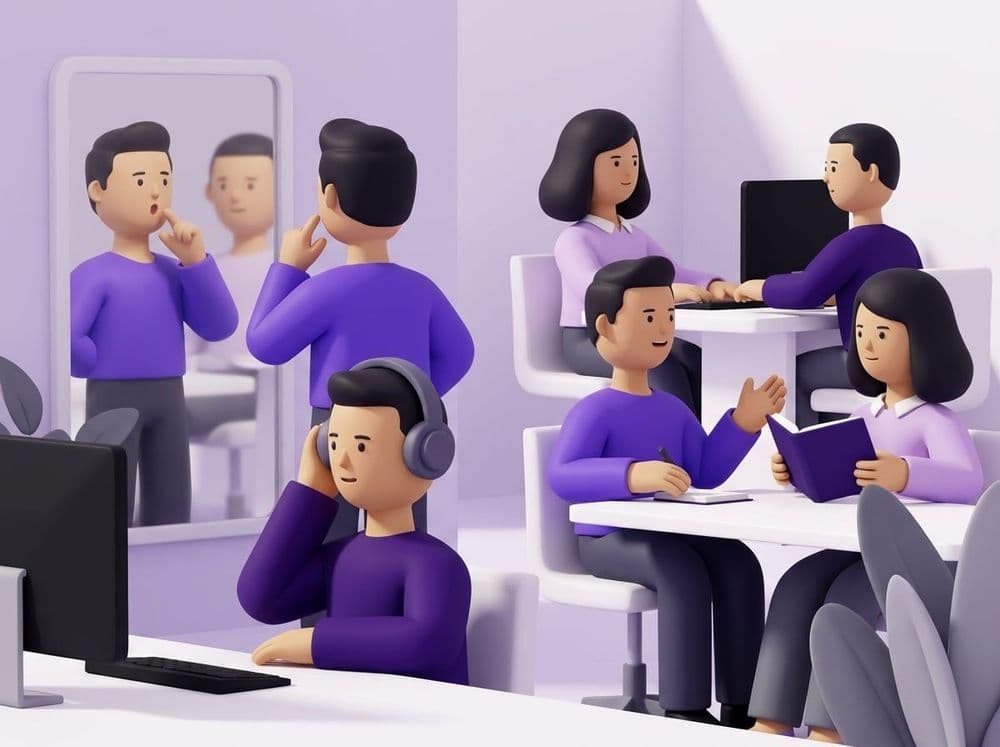
Master executive presence with actionable exercises to practice advanced English pronunciation for office workers. Build muscle memory for high-stakes meetings.

Cross-functional alignment in global corporate environments relies entirely on precise, comprehensible communication. Flat intonation or misaligned word stress can subtly erode a speaker's executive presence during high-stakes presentations. This guide outlines the specific physical articulation drills professionals use to practice advanced English pronunciation and build reliable muscle memory.
Key Takeaways
Below are the key takeaways in this guide:
- Noun-verb stress shifts: Placing emphasis on the correct syllable clarifies whether you are defining a strategy or executing an action.
- Connected speech: Linking consonant sounds to vowel sounds eliminates robotic pacing and creates a natural, authoritative rhythm.
- Intonation contours: Using a pitch glide softens diplomatic pushback during tense stakeholder negotiations.
- Active muscle memory: While free video tools teach anatomical pronunciation theory passively, Loora provides an AI Speaking Coach using native-speaker examples and immediate feedback so professionals can actively build muscle memory in a judgment-free environment.
Syllable Stress Drills for Executive Presence
Noun-verb stress shifts occur when the same word changes meaning based on which syllable is emphasized. Placing stress on the wrong syllable interrupts cognitive processing for the listener. That momentary confusion directly undermines your executive presence.
Last month, I observed a quarterly review where a brilliant director presented a new vendor contract. She pronounced it "con-TRACT" instead of "CON-tract." That slight phonetic shift confused the board, distracting them from her actual data. Advanced English pronunciation practice for professionals fixes these exact mechanical errors.
Let's execute three advanced speaking drills to isolate word stress.
Task 1: Isolate the Noun
Prompt: Read this sentence aloud: "We need to review the project estimate."
Answer Key: Stress the first syllable of each target word. Say "PRO-ject ES-ti-mate." The vowel in the final syllable of estimate reduces to a schwa.
Task 2: Isolate the Verb
Prompt: Read this sentence aloud: "We will contract an external vendor to implement the changes."
Answer Key: Stress the second and third syllables. Say "con-TRACT" and "im-ple-MENT." The shift signals an action rather than a physical document.
Task 3: Vowel Reduction (Schwa) in Unstressed Syllables
Prompt: Read this sentence aloud: "Please confirm the delivery status."
Answer Key: Stress the second syllable of confirm and the first syllable of status. Say "kən-FIRM the de-LI-ve-ry STA-təs." Notice how the 'o' in confirm and the 'u' in status reduce to a neutral schwa sound. Over-articulating unstressed vowels creates a staccato, unnatural rhythm that distracts stakeholders from your core message.
Intonation and Connected Speech for High Stakes Meetings
Connected speech seamlessly links the final consonant of one word to the starting vowel of the next word. This technique eliminates robotic pacing. Strategic intonation contours and pitch glides then layer on top of this rhythm to soften the blow of diplomatic pushback.
Knowing the mechanics of these pronunciation exercises for the workplace prepares you for real-time friction. Let's apply business English practice to high-stakes delivery.
Task 1: Consonant-to-Vowel Linking
Prompt: Read this sentence aloud: "Look at the variance in our operating expenses."
Reflection: Link the words to flow as a single sound block. Say "Loo-ka-the variance i-nour o-perating expenses." This continuous airflow projects vocal confidence and prevents choppy delivery.
Task 2: Pitch Glide for Diplomatic Tone
Prompt: Read this sentence aloud: "I see your point, but we need to re-evaluate the timeline."
Reflection: Apply a pitch glide on "point" and "but." Let your voice rise slightly on "point" to validate the stakeholder. Then drop your pitch firmly on "but" to anchor your authority. This creates a diplomatic tone without sacrificing your position.
Task 3: Thought Groups and Pausing for Impact
Prompt: Read this sentence aloud: "If we approve this budget, the engineering team can begin immediately."
Reflection: Divide the sentence into two distinct thought groups, utilizing breath control to pause at the comma. Apply a slight rising intonation on "budget" to signal the thought is incomplete, then a falling intonation on "immediately" to signal finality. Say "If we approve this budget [pause / rising pitch], the engineering team can begin immediately [falling pitch]." This mechanical pacing prevents rushing and projects an authoritative delivery.
How to Practice Free Tools Versus Artificial Intelligence English Tutors
Reading business English pronunciation drills provides the anatomical blueprint, but building true muscle memory requires active execution and real-time speech feedback. Passive video consumption can't correct your specific articulatory errors, so transitioning to interactive office pronunciation training determines your actual rate of improvement.
Comparing Pronunciation Practice Methods
| Dimension | General YouTube English Learning Channels | YouTube Pronunciation Breakdown (Rachel's English) | AI Speaking Coach (Loora) |
|---|---|---|---|
| Speaking focus | Focuses on passive listening and general vocabulary acquisition. The viewer absorbs content but never physically produces sounds. | Delivers detailed anatomical American pronunciation breakdowns. The learner receives visual instruction on mouth placement but practices without auditory verification. | Prioritizes active spoken output using Native Speaker Coaching. The platform leverages advanced speech recognition to analyze your specific accent and target the exact sounds you struggle with. |
| Scenario realism | Scenarios are scripted and designed for mass-market appeal. They rarely reflect the actual pressure of a corporate environment. | Practice sentences are highly controlled to highlight specific phonetic sounds. The scenarios don't adapt based on user input or professional context. | Simulates authentic workplace situations like client calls and performance critiques. The AI responds dynamically to replicate live business interactions and applies realistic stakeholder pushback. |
| Professional relevance | Content caters heavily to beginners focusing on casual conversation. It rarely addresses the specific linguistic needs of advanced professionals. | Highly relevant for neutralizing an accent and understanding phonetics. The focus remains on general American English mechanics rather than specific corporate registers. | Features specialized business modules and an expert-designed curriculum. The vocabulary directly aligns with advanced professional environments and high-stakes meetings. |
| Role-play flexibility | Zero flexibility exists within a pre-recorded video format. The learner must follow the creator's exact script and pacing. | Exercises strictly follow the provided phonetic drills. Users can't alter the vocabulary to match their own specific industry workflows. | Offers completely adaptable role-plays where users steer the conversation. The AI seamlessly adjusts to new topics and complex business discussions. |
| Multi-turn dialogue | Interaction is strictly one-directional. The learner absorbs information without engaging in a back-and-forth exchange. | Instruction flows only from the teacher to the student. There is no conversational continuation to test phonetic retention under pressure. | Sustains deep conversations across multiple turns. The AI asks clarifying questions to keep the user speaking continuously and building muscle memory. |
| Feedback depth | Personalized feedback is impossible. Learners must guess if their articulation matches the native speaker's example. | Provides excellent theoretical knowledge of mouth mechanics. The learner still lacks external confirmation of correct physical execution. | Delivers immediate feedback on pronunciation and grammar after every interaction. The system highlights specific mechanical errors for immediate correction. |
| Conversation pressure simulation | Watching a video is entirely passive. It completely fails to replicate the cognitive load of a real-time discussion. | Practicing isolated sounds carries zero stakes. The learner remains entirely in their comfort zone without real-time conversational demands. | Applies realistic pushback and asks unexpected follow-up questions. This safely simulates the pressure of a live boardroom in a judgment-free environment. |
| Context awareness | Videos treat all topics generically. The content can't recognize the user's specific industry or professional role. | The focus remains microscopically on phonetics. The instruction doesn't change based on situational context or business needs. | Understands the specific professional context of your chosen scenario. The AI adjusts its vocabulary and responses to match the required business register. |
| Preparation for real meetings | Builds passive listening comprehension. It doesn't prepare the articulatory muscles for continuous unpredictable speech. | Excellent for warming up isolated phonetic sounds. It doesn't prepare the speaker for the unpredictable flow of a Q&A session. | Directly bridges the gap between passive knowledge and active fluency. Rehearsing a presentation ensures your articulatory muscles are primed for live delivery. |
| Custom scenario creation | Users rely entirely on the search algorithm to find pre-made content. Customization for specific workplace challenges is impossible. | The curriculum is fixed to specific phonetic lessons. Users can't generate custom practice environments for their upcoming presentations. | Users can input their own specific contexts like a quarterly earnings presentation. The AI instantly generates a tailored practice environment for that exact situation. |
| Best real-world outcome | Expanded vocabulary recognition. The learner still struggles to physically produce the language actively during meetings. | A deep intellectual understanding of mouth mechanics. The user knows how sounds should be made but may falter in live conversation. | Confident delivery in high-stakes professional conversations. The user develops the muscle memory required to maintain executive presence under pressure. |
Conclusion
Advanced pronunciation is a purely mechanical skill that requires daily physical training rather than passive reading. Your cognitive grasp of the professional register is already excellent, so bridging the phonetic gap is simply a matter of consistent rehearsal. Applying these targeted pronunciation exercises alongside real-time correction will build the articulatory muscle memory necessary to command any boardroom.