

Advanced English Speaking Exercises for Unscripted Socializing
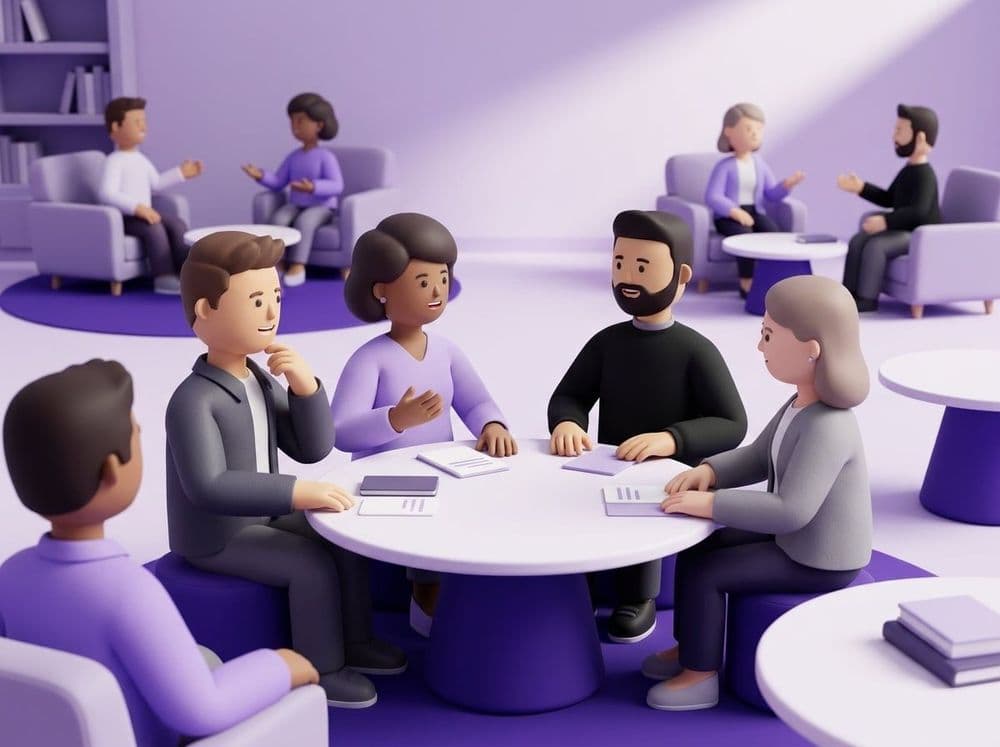
Want to build genuine connections? Discover advanced English speaking exercises for socializing to master group dynamics, turn-taking, and storytelling.

Networking mixers, dinner parties, casual work events, and late-evening group conversations all reward speakers who can read shifting group dynamics while the conversation is already moving. Advanced English speaking exercises for socializing need to train that live agility, because academic English rarely prepares you for overlapping turns, teasing banter, abrupt topic changes, and cultural nuance. This guide gives you actionable drills for turn-taking, polite interruption, storytelling, and topic bridging, then compares practice environments for building genuine social fluency.
Key Takeaways
Below are the key takeaways in this guide:
- Turn-taking mechanics: Smooth social English depends on timing, bridging phrases, and knowing when the room is ready for your voice.
- Storytelling rhythm: Strong anecdotes need pacing, intonation, and clean exits, not just impressive vocabulary.
- Polite interruption: Advanced speakers interrupt with active listening signals, which keeps conversational flow intact.
- Loora practice: Passive tools expose you to native speech, while Loora requires active participation through multi-turn role-plays and real-time feedback on your spoken output.
Exercise 1: Mastering Turn-Taking and Polite Interruption
Entering a fast-paced conversation is less about volume than timing. In advanced social English, the best interruption often sounds like agreement first, contribution second. A phrase such as "To build on what you just said..." signals active listening before you redirect the floor.
The most useful exercises to learn advanced English speaking skills for socializing train micro-timing. You're practicing the split-second moment between listening and entering, which is where group dynamics either open for you or close around you. Comprehensibility matters more than lexical complexity here. Clear, socially placed language wins.
Task: Choose one lively topic, such as remote work, travel habits, or food culture. Record yourself entering the discussion three different ways: agreement, contrast, and clarification.
Prompt: Use one of these discourse markers each time:
- "That's a good point, and I'd add..."
- "I see it slightly differently because..."
- "Can I pick up on that last part?"
- "To build on what you just said..."
Reflection: Listen back and assess three things: Did you acknowledge the previous speaker? Did your entry feel brief enough for a group setting? Did your tone sound collaborative rather than corrective? If the answer to any of those is unclear, shorten the phrase and soften the first word with warmer intonation.
This drill matters because turn-taking is not a grammar problem. It's a conversational flow problem, and flow improves when your entry phrase respects both the speaker and the room.
Exercise 2: Narrative Pacing for Engaging Storytelling
Advanced speakers often lose attention during anecdotes for one simple reason: every detail receives equal weight. I once watched a highly articulate speaker tell a funny travel story at a networking dinner, yet the group drifted before the punchline because the setup had no compression, no vocal contrast, and no clear signal that the story was going somewhere.
When he retold it later, he cut the background by half, slowed down before the surprising moment, and used a sharper closing line. Same vocabulary. Different pacing. That adjustment changed the room's attention because storytelling in English depends on rhythm as much as accuracy.
Strong speaking skills for socializing require narrative control: opening quickly, orienting the listener, building tension, and landing the point before the group moves on. Anecdotes work best when your intonation tells listeners which parts carry weight.
Task: Prepare a 45-second anecdote about a minor social surprise, such as a misunderstanding at dinner, an unexpected compliment, or a funny moment at a work event.
Prompt: Structure it in four beats:
- Context: "So, I was at..."
- Shift: "Then, out of nowhere..."
- Reaction: "At first, I thought..."
- Point: "The funny thing was..."
Reflection: Record the story twice. In the second version, add one strategic pause before the shift and vary your intonation on the reaction line. Then ask: Did the story move faster? Did the pause create anticipation? Did the ending feel like a clean handoff back to the group?
Narrative pacing gives your personality room to surface in English. Without it, even a good story can feel like a report.
Exercise 3: Transitioning from Small Talk to Authentic Connection
Small talk is not trivial. It creates social safety, tests register, and gives both speakers time to read the room. The advanced problem begins when every exchange stays at the surface: weather, work, travel, weekend plans, then an elegant dead end.
Effective social English practice trains topic bridging, not just question formation. The move is to treat safe topics as entry points into values, preferences, and lived experience, which is where authentic connection becomes possible.
Task: Take one safe topic and create three open-ended follow-up questions that move one step deeper without sounding intrusive.
Prompt: Start with work, travel, or food, then bridge like this:
- "What got you interested in that kind of work?"
- "What kind of places do you usually feel drawn to?"
- "What's a meal that feels connected to home for you?"
Reflection: Check whether your question invites a story, not a yes-or-no reply. Then prepare one follow-up that proves active listening: "That's interesting, what changed your mind about it?" This keeps the exchange human, responsive, and unscripted.
Where to Practice Social English: Passive Video vs. Interactive AI
Knowing how to practice social English means choosing an environment that trains spontaneous response, not just recognition. YouTube language lessons can sharpen listening and expose you to cultural texture, while interactive AI practice is better suited to rehearsing unscripted social moves aloud.
Practice Environment Comparison
| Practice dimension | AI English Tutor Loora | YouTube English Learning Channels |
|---|---|---|
| Speaking focus | Loora centers practice on live spoken output through conversation, role-play, and immediate correction. You produce language, then adjust it in real time. | YouTube excels at input: listening to native speakers, observing phrasing, and noticing informal registers. It does not require spoken participation. |
| Scenario realism | Loora runs interactive, multi-turn role-plays and natural conversations where responses can shift based on what you say. That supports rehearsal for a networking mixer or a post-event social exchange. | YouTube can show realistic social clips and teacher demonstrations, which helps with cultural observation. The scenario stays fixed because the video cannot react to your response. |
| Role-play flexibility | Loora offers built-in starter scripts that adapt to your level and industry, plus custom scenarios for specific professional contexts. You can rehearse a real upcoming exchange before it happens. | YouTube provides many lesson topics, from small talk to idioms. You select content, but you cannot steer the scene or assign yourself a responsive role. |
| Multi-turn dialogue | Loora supports back-and-forth interaction, follow-up questions, and realistic pushback during role-play. That trains the mental speed required when a group conversation changes direction. | YouTube models dialogue well, but the interaction remains one-way. You can shadow or pause the video, yet the speaker will not challenge or redirect you. |
| Feedback depth | Loora highlights pronunciation and grammar issues during conversation, then provides post-conversation review with native-speaker examples. Its Takeaways feature can also focus your review on grammar, pronunciation, or vocabulary. | YouTube can explain common mistakes and demonstrate natural expressions. Feedback depends on your self-assessment because the platform does not evaluate your spoken output. |
| Social pressure simulation | Loora can ask follow-up questions and apply realistic pushback, which helps you rehearse the pressure of entering a debate or keeping a story moving. The exchange stays active. | YouTube lets you observe pressure from a distance, such as fast banter or panel-style talk. That exposure is useful, but it does not recreate the burden of answering in the moment. |
| Context awareness | Loora lets you set a custom practice context, such as a networking conversation after a conference session. Starter scripts can also adapt to level and professional setting. | YouTube offers broad cultural and linguistic context through videos from many speakers. The content remains the same for every viewer unless you curate your own playlist. |
| Preparation for social events | Loora prepares you to speak, adjust, clarify, and recover during live social interaction. It builds the muscle memory behind turn-taking and topic bridging. | YouTube prepares you to recognize phrasing, humor, and cultural cues. It works best as input before active practice, not as a substitute for speaking. |
The practical distinction is straightforward: YouTube helps you notice how social English sounds, while Loora makes you perform it. For advanced conversation drills, that active loop matters because turn-taking, polite interruption, and storytelling rhythm only become usable when you practice them under responsive, multi-turn conditions.
Conclusion
Social fluency is a professional and personal communication skill, not an innate gift reserved for naturally extroverted speakers. The exercises above train the mechanics that carry personality into English: entering a group smoothly, pacing anecdotes, asking deeper follow-ups, and adapting register as the room changes.
Vocabulary and awareness matter, but they only become reliable when you use them in live speech. Pair these advanced conversation drills with active practice in a responsive tool like Loora, and you can build the muscle memory needed for authentic connection in fast-moving social settings, from a networking mixer to a dinner conversation that shifts without warning.